What Is WireGuard?
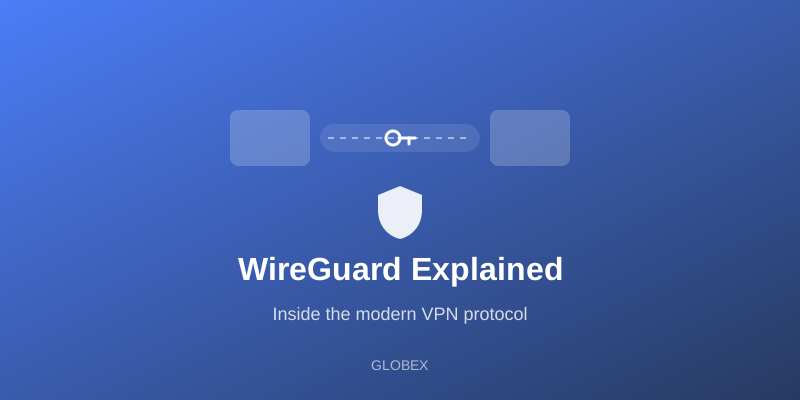
In short: WireGuard is a modern, open-source VPN protocol built around a radical idea — do less, but do it perfectly. Where older protocols grew into sprawling codebases with dozens of configuration options, WireGuard fits in a few thousand lines of code, uses one fixed set of modern cryptographic primitives, and lives inside the operating system kernel. The result is a protocol that is fast, easy to audit, and hard to misconfigure. This is an educational deep-dive into how it works; note that not every VPN service uses WireGuard, and for some network conditions other protocol designs are a deliberate choice.
WireGuard began as a research project by Jason Donenfeld and reached a major milestone in 2020 when it was merged into the Linux kernel — a strong signal of code quality, since kernel inclusion requires intense scrutiny. Today it underpins many commercial VPN apps and countless self-hosted setups.
The Design Philosophy: Small Is Secure
The most important thing about WireGuard is not any single feature but its size. Security researchers describe code as an "attack surface": every line is a place where a bug — and therefore a vulnerability — can hide. Older VPN protocols accumulated decades of options, cipher negotiations, and compatibility layers, which makes them powerful but genuinely difficult to audit end to end.
WireGuard's authors went the other way. The protocol:
- Implements one cryptographic suite, not a menu. There is no cipher negotiation phase, because negotiation logic has historically been a rich source of downgrade attacks.
- Fits in a codebase small enough for a single expert to read. Independent audits become practical rather than aspirational.
- Leaves out what it does not need. No built-in user management, no certificate infrastructure, no plugin system. Those jobs are pushed up to the application layer.
This minimalism is why WireGuard earned trust unusually quickly for a security protocol.
The Cryptography Inside
WireGuard uses a fixed set of modern primitives, chosen once and baked in:
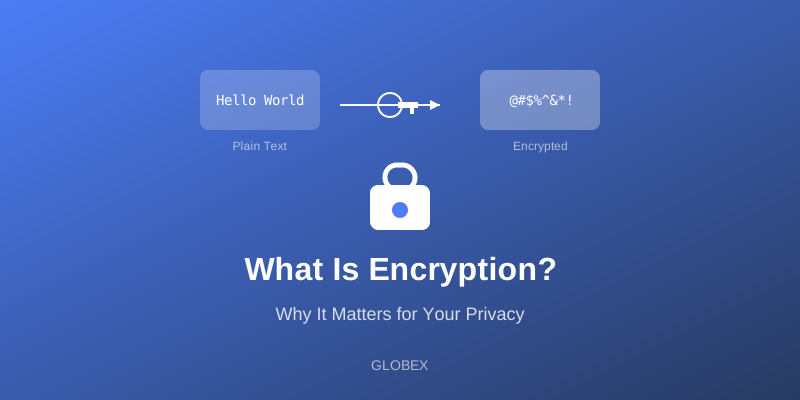
- ChaCha20-Poly1305 for encrypting and authenticating traffic — a cipher that runs fast even on phones without dedicated encryption hardware.
- Curve25519 for key exchange, the elliptic-curve function used across much of the modern internet.
- BLAKE2s for hashing and HKDF for deriving session keys.
- The Noise Protocol Framework for the handshake, giving forward secrecy: session keys rotate regularly, so even if a key leaked, past traffic stays sealed.
Identity in WireGuard is refreshingly simple: each peer has a public/private key pair, much like SSH. You share your public key with the server, it shares its public key with you, and the handshake does the rest — no usernames, passwords, or certificate chains inside the protocol itself.
Why It Is Fast
Three design choices explain WireGuard's reputation for speed. First, it runs inside the kernel on supported platforms, so packets do not bounce between kernel space and a user-space program the way they do with some older protocols. Second, ChaCha20 is extremely efficient on ordinary CPUs, which matters most on mobile devices. Third, the handshake is tiny — a connection establishes in roughly a single round trip, and reconnecting after your phone switches from Wi-Fi to mobile data is nearly instant. That last property, seamless roaming, is one of the features users notice most in daily life.
What WireGuard Does Not Solve
An honest explanation has to include the limitations, because they are real and they shape how services deploy the protocol:
- It does not try to hide that it is a VPN. WireGuard packets are encrypted, but their pattern is recognizable to deep packet inspection. On heavily filtered networks that actively block VPN traffic, plain WireGuard connections can simply be dropped. Protocols designed for censorship resistance take a different approach — disguising traffic as ordinary web browsing — which is a different engineering goal entirely.
- It runs over UDP only. Some restrictive networks throttle or block unfamiliar UDP traffic, and WireGuard has no built-in TCP fallback.
- Privacy plumbing is left to the provider. By default a WireGuard server holds a table of peer public keys and their last-seen IP addresses. Commercial VPNs layer their own systems on top to avoid retaining that data — the protocol itself does not handle it.
- No dynamic user management. Issuing, rotating, and revoking keys at the scale of a consumer VPN service requires infrastructure the protocol deliberately does not include.
None of these are flaws in what WireGuard set out to do; they are boundaries of the problem it chose to solve.
How WireGuard Fits the Wider Protocol Landscape
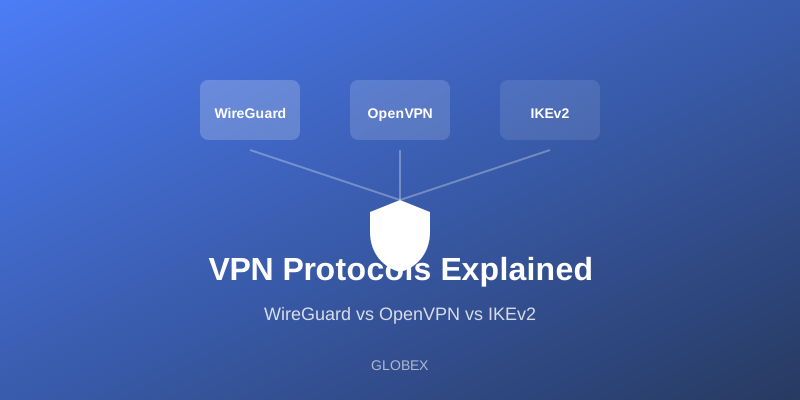
The protocol world is not a single race with one winner — it is a set of tools matched to network conditions. WireGuard excels on open networks where speed and simplicity matter most. IKEv2 remains a strong choice on mobile, with mature operating-system integration. OpenVPN's TCP mode traverses restrictive firewalls that UDP-only designs cannot. And on networks that actively detect and block VPN traffic, encrypted-proxy protocols such as Shadowsocks, V2Ray/Reality, and Hysteria2 are built specifically to look like ordinary internet traffic — a job WireGuard never took on.
That is why different VPN services make different choices. GLOBEX uses IKEv2 and modern encrypted-proxy protocols (Reality, Hysteria2) rather than WireGuard, because GLOBEX is engineered first for restrictive networks where censorship resistance — traffic that blends in rather than merely encrypts — is the deciding factor. If you want to compare protocol families side by side, our guide to VPN protocols walks through the trade-offs in detail.
The Bottom Line
WireGuard is one of the most important things to happen to VPN technology in the last decade: a protocol small enough to audit, fast enough to forget it is running, and secure by construction rather than by configuration. Understanding it also clarifies the bigger truth about VPN protocols — every design is a set of trade-offs, and the right protocol depends on the network you are on and the problem you need solved.