What Is Encryption?
TL;DR: Encryption scrambles readable data into a form only the holder of the right key can decode. It is the invisible technology behind safe banking, private messaging, and VPNs. Strong modern ciphers like AES-256 and ChaCha20 are effectively impossible to brute-force, which is why an encrypted connection stays private even if someone intercepts it.
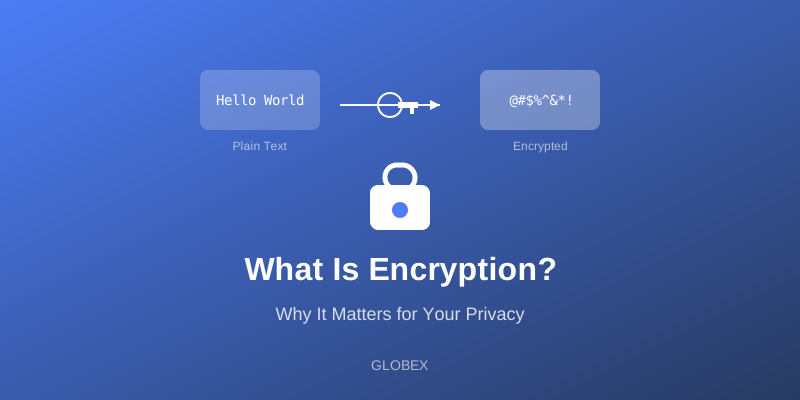
Encryption is the process of converting readable data into an unreadable format that can only be decoded with the correct key. Think of it like a secret language that only you and the intended recipient understand; to everyone else, the message is meaningless noise.
You use encryption constantly without noticing. The padlock in your browser, your messaging apps, your online banking, and your VPN all rely on it. It is the single technology that makes it safe to send a password or a credit card number across a network full of strangers. Without it, the modern internet simply could not be trusted with anything private.
How Encryption Works
The Basic Process
1. Plaintext - Your original, readable data
2. Encryption algorithm - A mathematical formula that scrambles the data
3. Encryption key - The secret code used to encrypt and later decrypt it
4. Ciphertext - The scrambled, unreadable result that travels across the network
The security does not come from keeping the algorithm secret, since strong algorithms are public and heavily studied. It comes from keeping the key secret. A good cipher is one that remains unbreakable even when an attacker knows exactly how it works, as long as they do not have the key.
Types of Encryption
#### Symmetric Encryption
The same key both encrypts and decrypts. It is very fast, which makes it ideal for encrypting large amounts of data, but it raises a hard question: how do two parties securely share the key in the first place?
#### Asymmetric Encryption
This uses a key pair, a public key to encrypt and a private key to decrypt. Anyone can encrypt a message to you using your public key, but only your private key can open it. This elegantly solves the key-sharing problem.
#### How They Work Together
In practice, most secure connections combine both. Asymmetric encryption is used briefly to safely exchange a shared symmetric key, then the faster symmetric encryption handles the bulk of the conversation. This hybrid approach gives you the security of one and the speed of the other.
Encryption in VPNs
VPNs use encryption to protect your internet traffic from your ISP, hackers, and anyone monitoring the network. Common VPN encryption includes:
AES-256
- An advanced, widely trusted standard used by governments and banks
- A 256-bit key length, giving an astronomically large number of possible keys
- Brute-forcing it with current technology would take far longer than the age of the universe
ChaCha20
- A modern stream cipher that runs faster than AES on devices without dedicated hardware acceleration
- Especially efficient on phones, where it saves battery
- Considered equally secure to AES-256
Why Encryption Matters
Protects Your Data
Even if your traffic is intercepted on a public network, encrypted data is useless to an attacker without the key.
Secures Communications
Emails, messages, and calls stay private between you and the person you are talking to.
Enables Online Commerce
Every credit card transaction and online purchase depends on encryption to keep payment details safe in transit.
Preserves Privacy
Your ISP, network operators, and would-be snoops cannot read encrypted traffic, so your browsing stays your own business.
What Encryption Does Not Do
It is worth being clear about the limits. Encryption protects data in transit and at rest, but it cannot protect you from a weak password, a phishing trick that hands over your key, or malware already on your device. It also does not hide who you are talking to or how often, only what you are saying. Treat encryption as one essential layer in a broader security routine, not a complete shield on its own.
Encryption in Transit vs Encryption at Rest
A useful distinction is where the data sits when it is protected. Encryption in transit protects information as it travels across a network, which is what HTTPS and a VPN provide. Encryption at rest protects information while it is stored, such as files on an encrypted phone or laptop, or backups in the cloud. Both matter for different reasons: in-transit encryption stops interception on the wire, while at-rest encryption stops someone who physically gets hold of your device or storage from reading it. Strong security uses both, so a stolen laptop and a sniffed connection are equally useless to an attacker.
Why Key Length and Modern Ciphers Matter
You will often see numbers like 128-bit and 256-bit attached to encryption. The number refers to how many possible keys exist, and each extra bit doubles that count. A 256-bit key has so many possibilities that trying them all is not just impractical but physically infeasible with any foreseeable conventional technology. That said, key length is only part of the story; the algorithm must also be free of design flaws and implemented correctly. This is why the security community favours a small set of well-studied, public ciphers like AES and ChaCha20 over obscure or homemade alternatives. A trusted, properly implemented cipher with a strong key is what turns "encrypted" from a marketing word into real protection.
GLOBEX's Encryption
GLOBEX uses modern, strong encryption, including ChaCha20, to protect everything that travels through the tunnel, providing:
- Fast performance, even on mobile networks
- Robust, well-tested security
- Low battery consumption on phones
Encryption is the quiet foundation of everything you trust online, from a simple login to a bank transfer to a private message. You do not need to understand the mathematics to benefit from it; you only need to use tools that apply strong, modern ciphers correctly and to recognise that encryption protects what you send, not who you are or how careful you are with your keys. Pair good encryption with strong passwords, two-factor authentication, and a healthy wariness of phishing, and you have the core of a genuinely secure digital life. Your data is encrypted from the moment it leaves your device until it reaches our server, so it stays safe with GLOBEX.