Two Protocols, Two Philosophies
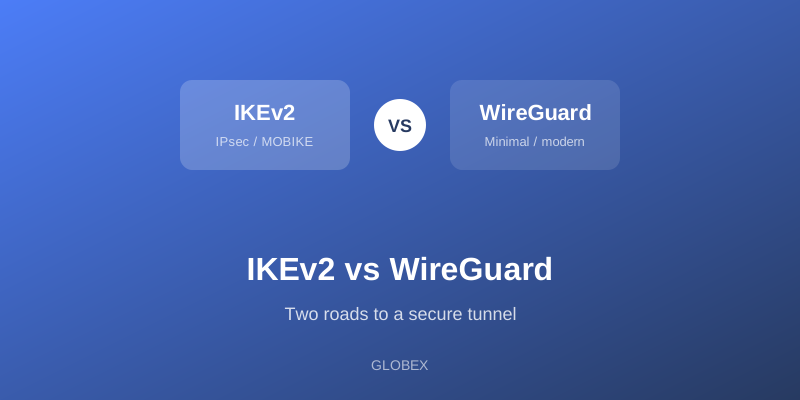
In short: IKEv2/IPsec and WireGuard are both modern, well-regarded VPN protocols, and for most everyday use either one is fast and secure. The interesting part is how differently they get there. IKEv2 is the product of decades of standards work — flexible, deeply integrated into operating systems, and battle-tested in enterprise networks. WireGuard is a deliberate rebellion against that complexity: a tiny, opinionated protocol built around a single fixed set of modern cryptography.
This is an educational comparison of the two designs. Note where GLOBEX stands up front: GLOBEX uses IKEv2 and modern encrypted-proxy protocols (Reality, Hysteria2) rather than WireGuard — so if you're evaluating our app, IKEv2 is the half of this comparison you'll actually use.
What Is IKEv2?
IKEv2 (Internet Key Exchange, version 2) is the key-negotiation protocol of the IPsec suite, standardized by the IETF and refined since the mid-2000s. When people say "IKEv2 VPN," they mean IKEv2 handling authentication and key agreement, with IPsec encrypting the actual traffic.
Its defining strengths:
- Native OS integration. Major operating systems ship IKEv2/IPsec support built in, and encryption can benefit from hardware acceleration — good for both speed and battery life on phones.
- MOBIKE mobility. IKEv2 supports MOBIKE, a standardized mechanism for surviving network changes. Walk out of WiFi range onto mobile data and the tunnel re-anchors to the new address without a full reconnect. This made IKEv2 a favorite for mobile VPNs long before newer protocols existed.
- Fast handshake. Session establishment takes few round trips, so connections and reconnections feel quick.
- Cryptographic agility. Algorithms are negotiated, not fixed. That flexibility lets deployments adopt new ciphers over time — at the cost of configuration surface that must be kept sane.
- Maturity. Two decades of analysis, deployment, and standards scrutiny. The failure modes are well understood.
The honest weaknesses: the IPsec stack is large and complex, misconfiguration is possible in a way a fixed-crypto protocol can't be, and IKEv2's use of UDP ports 500/4500 makes it recognizable — networks that want to block VPNs can block it fairly easily.
What Is WireGuard?
WireGuard arrived in the Linux kernel in 2020 with a radical premise: a VPN protocol small enough to audit. Where the IPsec ecosystem spans hundreds of thousands of lines of code, WireGuard's core is only a few thousand.
Its defining strengths:
- Minimal, auditable codebase. Less code means less room for bugs and a realistic chance of thorough review.
- Fixed modern cryptography. ChaCha20-Poly1305, Curve25519, BLAKE2s — no negotiation, no downgrade paths, no configuration mistakes in cipher choice. If the crypto ever needs replacing, the protocol version changes wholesale.
- Excellent performance. In-kernel operation and a lean handshake give WireGuard superb throughput and latency in most published benchmarks.
- Fast roaming. Like IKEv2, WireGuard handles endpoint changes gracefully — sessions survive network switches with minimal fuss.
The honest weaknesses: out of the box WireGuard maps each user to a static internal IP, so privacy-conscious providers must add their own mitigation layers (rotating or ephemeral IP assignment); it has no built-in user authentication system (key distribution is the deployment's problem); and its traffic pattern, like IKEv2's, is identifiable — neither protocol tries to hide the fact that a VPN is in use.
Head-to-Head
| Dimension | IKEv2/IPsec | WireGuard |
|---|---|---|
| First standardized/released | Mid-2000s (IETF) | 2020 (Linux kernel mainline) |
| Codebase size | Large (full IPsec stack) | Very small (few thousand lines in core) |
| Cryptography | Negotiated, flexible | Fixed modern suite |
| Speed | Fast, hardware-accelerated | Typically fastest in benchmarks |
| Network switching | Excellent (MOBIKE) | Excellent (built-in roaming) |
| OS support | Built into major operating systems | Kernel-native on Linux; apps elsewhere |
| Blockability | Recognizable (UDP 500/4500) | Recognizable (distinctive UDP traffic) |
| Best fit | Mobile stability, OS integration, enterprise | Raw speed, simplicity, auditability |
The Censorship Angle — Where Both Fall Short
Here's the dimension comparison articles usually skip: on a network that actively blocks VPNs, the IKEv2-vs-WireGuard debate is moot, because both are straightforward for a firewall to identify and drop. Neither was designed to be indistinguishable from ordinary traffic.
That's why protocols like Reality (part of the V2Ray family) and Hysteria2 exist — encrypted-proxy designs whose traffic is engineered to blend in with normal HTTPS. On heavily filtered networks, a protocol that connects beats a marginally faster protocol that's blocked, every time. This is the design space GLOBEX concentrates on: the app pairs IKEv2 with censorship-resistant protocols such as Reality and Hysteria2, engineered for restrictive networks. For a broader tour of the protocol landscape, see our VPN protocols explainer.
So Which Should You Choose?
- If your VPN app offers both, try each on your real networks. Differences in your ISP's routing usually matter more than the protocol's benchmark numbers.
- If mobility and battery life on a phone are the priority, IKEv2's OS integration and MOBIKE make it a proven choice.
- If you're self-hosting and want minimal moving parts, WireGuard's simplicity is hard to beat.
- If you're on a restrictive network, neither is the answer — you want obfuscated protocols like Reality or Hysteria2.
To be clear about GLOBEX one more time: the app offers 8 connection protocols on the free tier — the same set as Premium — including IKEv2, Shadowsocks, V2Ray/Reality, Hysteria2, and OpenVPN, and it selects a working protocol for you automatically. GLOBEX does not include WireGuard; this article covers it because understanding the comparison helps you evaluate any VPN honestly. You can see the full picture on our features page.
Conclusion
IKEv2 and WireGuard are both excellent answers to the question "how do I build a fast, secure tunnel?" — one through mature, flexible standards with deep OS integration, the other through ruthless minimalism and fixed modern crypto. For everyday privacy on an open network, you'd be well served by either. The moment the network itself becomes hostile, the conversation changes from speed to stealth — and that's a different family of protocols entirely.