What Is a VPN Protocol?
TL;DR: A VPN protocol is the rule set that governs how your data is encrypted and routed to a VPN server. WireGuard is fastest, OpenVPN is the most battle-tested, and IKEv2 excels on mobile. No single protocol wins everywhere, so the best apps switch automatically based on your network and location.
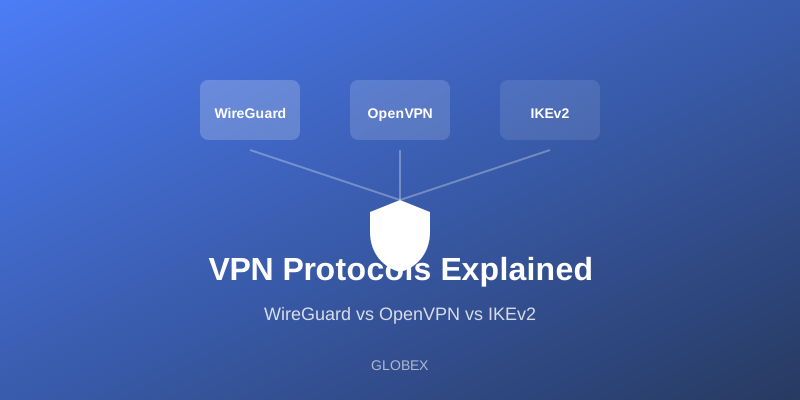
A VPN protocol is the set of rules that determines how your data travels between your device and the VPN server. Think of it as the language your VPN speaks. The protocol decides which encryption ciphers are used, how the secure tunnel is negotiated, how lost packets are recovered, and how quickly the connection re-establishes if your network drops. Two VPNs using the same servers can feel completely different simply because they default to different protocols.
Understanding protocols matters because the right choice affects three things you actually notice: how fast pages load, how long your battery lasts, and whether you can connect at all on a restrictive network. The wrong protocol can drain your phone, stall on a hotel WiFi captive portal, or get blocked outright by a censoring firewall.
The Major VPN Protocols
WireGuard - The New King
WireGuard is the newest mainstream VPN protocol, and it has reshaped expectations for speed and simplicity across the industry.
Pros:
- Extremely fast, often noticeably quicker than OpenVPN
- Very small codebase (around 4,000 lines), which makes it far easier to audit for security flaws
- Lower battery consumption on mobile devices
- Near-instant connection times, even after your network changes
Cons:
- Newer, so it has had less time in the field than OpenVPN
- Its default configuration assigns static internal IPs, which providers must handle carefully to protect privacy
Best for: Speed-focused users, mobile devices, and streaming.
OpenVPN - The Trusted Veteran
OpenVPN has been the industry standard for over 15 years and remains the protocol security researchers trust most.
Pros:
- Extremely secure and thoroughly audited over many years
- Highly configurable, with support for both TCP and UDP transport
- Runs on almost any device or operating system
- Fully open source
Cons:
- Slower than WireGuard in most real-world tests
- Can be complex to configure manually
- Higher battery drain on phones
Best for: Maximum security, compatibility with older systems, and situations where you want a protocol with a long public track record.
IKEv2/IPsec - The Mobile Champion
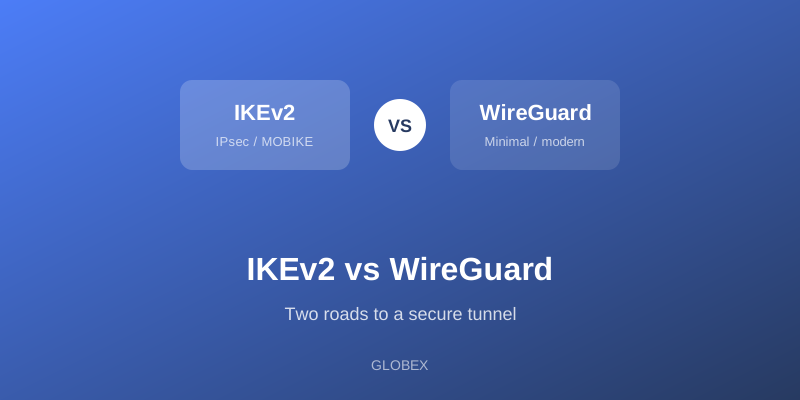
IKEv2 was developed jointly by Microsoft and Cisco and is built into most modern operating systems.
Pros:
- Excellent for mobile because it reconnects seamlessly when you switch between WiFi and cellular
- Fast connection establishment
- Strong, well-understood security
Cons:
- Not open source in its original form
- Uses fixed UDP ports that some firewalls can detect and block
Best for: Mobile users who constantly move between networks and want a connection that recovers instantly.
Shadowsocks and XRay - The Censorship Fighters
Where WireGuard, OpenVPN, and IKEv2 are designed for speed and security on open networks, Shadowsocks and XRay (a Reality-based protocol) are designed to look like ordinary HTTPS traffic. This matters in countries that use deep packet inspection to detect and block VPN connections.
Pros:
- Disguise VPN traffic as normal web browsing, slipping past censorship firewalls
- Hard for network operators to fingerprint and block
- Effective where conventional protocols are detected and dropped
Cons:
- Add a small amount of overhead compared to raw WireGuard
- Most useful in restrictive regions rather than open networks
Best for: Users in heavily censored regions who simply need a connection that works.
Speed Comparison
| Protocol | Speed | Security | Battery |
|---|---|---|---|
| WireGuard | Excellent | Excellent | Low drain |
| OpenVPN | Good | Excellent | High drain |
| IKEv2 | Very Good | Good | Medium drain |
| Shadowsocks/XRay | Good | Very Good | Medium drain |
How to Choose the Right Protocol
If you mostly browse and stream on home or office WiFi, prioritise speed and reach for WireGuard. If you switch networks all day on your phone, IKEv2 will give you the smoothest experience. If you care most about a long, public security record, OpenVPN is the conservative pick. And if you are travelling through or living in a region with aggressive censorship, an obfuscation protocol like Shadowsocks or XRay is the only thing that will reliably get you online.
The good news is that you rarely have to make this decision by hand. A well-built VPN tests your network conditions and picks the protocol that connects fastest and most reliably, then quietly falls back to another if the first one is blocked.
Why GLOBEX Uses Multiple Protocols
At GLOBEX, we use a multi-protocol approach built around IKEv2, Shadowsocks, and XRay because:
1. Reliability - Automatic fallback keeps you connected even when an ISP blocks one protocol. If the first attempt fails, the app advances to the next option without you doing anything.
2. Speed - IKEv2 provides fast, efficient connections with minimal battery drain, which is ideal for everyday mobile use.
3. Anti-censorship - Shadowsocks and XRay disguise your traffic to bypass deep packet inspection in restrictive countries, so the connection works where ordinary VPNs are detected and dropped.
This is the key insight most protocol comparisons miss: the goal is not to crown one winner. It is to have the right tool ready for every network you encounter and to switch between them automatically.
Conclusion
All of the protocols discussed above are secure when implemented correctly. The real lesson is that no single protocol works everywhere, in every country, on every network. WireGuard wins on raw speed, OpenVPN on its long security record, IKEv2 on mobile stability, and obfuscation protocols on censorship resistance. That is exactly why GLOBEX intelligently selects the best protocol for your location and connection instead of locking you into one. Download GLOBEX and let it handle the protocol choice for you.