The Quantum Threat to Encryption
TL;DR: Powerful future quantum computers could break the public-key encryption that secures much of today's internet. The urgent part is "harvest now, decrypt later", where attackers store encrypted data today to crack once quantum machines mature. Post-quantum cryptography is the answer, and forward-looking VPNs are already adopting hybrid schemes to protect your data well before that day arrives.
Quantum computers are advancing steadily. When they become powerful and stable enough, a class of them could break some of the encryption that protects our digital world today. This is not science fiction or a distant abstraction; governments and standards bodies are already preparing for it, and the migration to quantum-resistant security has begun.
It is important to be precise about what is actually threatened. The danger is mainly to public-key (asymmetric) cryptography, the part of encryption used to exchange keys and verify identities. Symmetric encryption like AES is far more resilient and can largely be future-proofed by using longer keys. Understanding that distinction keeps the threat in proportion: it is serious, but it is specific and solvable.
Understanding the Problem
How Current Encryption Works
Today's public-key encryption relies on mathematical problems, such as factoring very large numbers, that are practically impossible for conventional computers to solve in any reasonable time.
Why Quantum Computers Are Different
Quantum computers exploit the properties of quantum mechanics to approach certain problems in fundamentally new ways. For a few specific problems, including the ones underpinning today's public-key cryptography, a sufficiently large quantum computer could solve them dramatically faster than any classical machine.
What's at Risk
- The key exchange that sets up VPN connections
- Banking and payment security
- Secure messaging and email
- Digital signatures that verify software and websites
- Stored encrypted data captured today and saved for later
The "Harvest Now, Decrypt Later" Problem
This is why the threat is urgent even though capable quantum computers do not yet exist. An adversary can record encrypted traffic or steal encrypted archives today, store them cheaply, and simply wait. The moment a powerful enough quantum computer arrives, all of that harvested data becomes readable retroactively. For anything that must stay secret for years, the clock is already ticking, which is why the move to quantum-resistant encryption cannot wait for the hardware to appear.
Post-Quantum Cryptography (PQC)
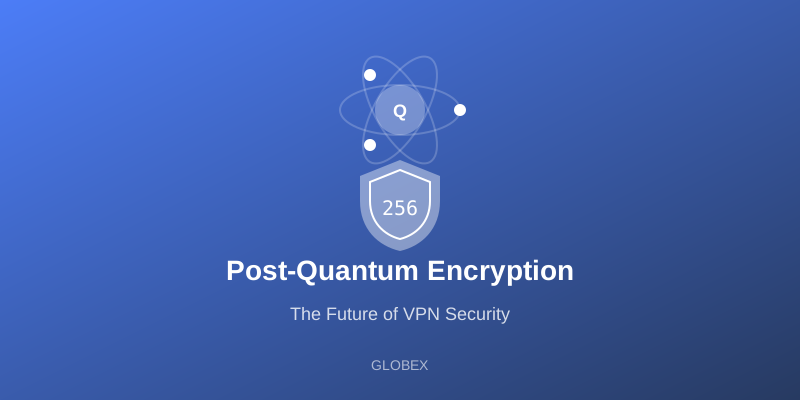
Post-quantum cryptography uses new algorithms designed to resist attacks from both classical and quantum computers. Crucially, these algorithms run on today's ordinary hardware; they do not require a quantum computer to use, only to defend against one.
Leading PQC Algorithms
- CRYSTALS-Kyber - Selected by standards bodies for key exchange
- CRYSTALS-Dilithium - A leading choice for digital signatures
- SPHINCS+ - A conservative, hash-based alternative for signatures
The Timeline
Estimates for when a cryptographically relevant quantum computer might exist vary, with many experts pointing to a window of roughly the next 10 to 15 years. Because of the harvest-now-decrypt-later risk, however, the security community is acting now rather than waiting for that milestone.
How VPNs Are Preparing
Forward-looking VPN providers are adopting hybrid encryption that runs a classical algorithm and a post-quantum one side by side. If either one is ever broken, the other still protects the connection, which makes hybrid schemes a safe way to migrate without betting everything on a brand-new algorithm.
Current Status
- Research, testing, and standardisation are well underway
- Early hybrid implementations are appearing in shipping products
- A broader transition is expected over the coming years
What This Means for You
Today
Current VPN encryption remains secure against the computers that actually exist right now. The practical step is simply to use a VPN from a provider that keeps its cryptography current.
Tomorrow
As post-quantum and hybrid options mature, favour providers that adopt them, especially if you handle data that must remain confidential for a long time.
Should You Worry About This Today?
For most everyday users, the honest answer is: be aware, but do not panic. The encryption protecting your banking, messaging, and VPN traffic right now is secure against every computer that currently exists, and that will remain true for years. The genuine concern is narrow and specific: data that must stay confidential for a very long time, such as state secrets, medical records, or long-lived business intelligence, is exposed to the harvest-now-decrypt-later strategy and should already be moving to quantum-resistant protection. For routine personal traffic that loses its value within days or weeks, a captured packet is of little use by the time any quantum computer could decode it.
How to Future-Proof Your Privacy
The practical advice is reassuringly simple. Choose security tools from providers that actively maintain their cryptography and publish what they use, rather than ones that set it once and forget it. Favour services that have announced concrete plans for post-quantum or hybrid encryption. Keep your apps and devices updated, since cryptographic upgrades arrive through those updates. And keep your expectations grounded: the migration to post-quantum cryptography is a multi-year, industry-wide effort being handled by standards bodies and vendors, not something an individual needs to engineer. Your job is mainly to pick tools that take it seriously and to keep them current.
GLOBEX's Commitment
At GLOBEX, we follow developments in cryptography closely and intend to adopt post-quantum and hybrid protections as the standards and tooling mature, so your data stays protected against both today's threats and tomorrow's.
The quantum era is coming, but it is arriving on a timeline the security industry is actively preparing for, not catching anyone by surprise. The encryption that protects you today remains strong, the algorithms to replace the vulnerable parts already exist and run on ordinary hardware, and the transition to hybrid and post-quantum schemes is well underway across browsers, messaging apps, and VPNs. For you, the right posture is calm vigilance: understand the harvest-now-decrypt-later risk, protect genuinely long-lived secrets sooner rather than later, and choose providers that treat their cryptography as something to maintain and upgrade over time. Do that, and your privacy will carry forward from today's threats into tomorrow's intact. Stay protected today and tomorrow with GLOBEX.