What Is a VPN Device Limit?
In short: A device limit (also called a simultaneous-connection limit) is a cap on how many of your devices can use one VPN subscription at the same time. It is one of the most common — and least talked about — restrictions in the VPN industry. This guide explains why these limits exist, how they affect real households, and what to look for when a provider says "unlimited devices."
When you sign up for most VPN services, you are not really buying protection for *you* — you are buying protection for a fixed number of *devices*. If your plan allows a set number of simultaneous connections and you try to connect one device more than that, the extra device is typically refused, or an older session is silently disconnected. The limit usually applies to devices connected *at the same time*, not to how many devices you have installed the app on, though a few providers have historically enforced installation-based caps as well.
Why Do VPN Providers Cap Devices?
Device limits are not arbitrary. They exist for a mix of business and technical reasons:
- Preventing account sharing — A single account shared across an entire dormitory or an online forum costs the provider real bandwidth while generating revenue from just one subscription. Connection caps are the bluntest tool for limiting that behavior.
- Capacity planning — Every active tunnel consumes memory, processing capacity, and bandwidth on a VPN server. Capping connections per account makes server load easier to predict.
- Upselling — Device limits create a natural upgrade path. A household that outgrows its cap is a household that can be sold a bigger plan. Tiered device counts are a pricing lever, not just an engineering constraint.
- Abuse control — Automated abuse (bots, scrapers, credential-stuffing tools) often tries to multiplex many sessions through one account. A per-account connection cap raises the cost of that abuse.
None of these reasons is illegitimate. But it is worth understanding that the limit printed on a pricing page is primarily a *business* decision. The same infrastructure that serves a five-device account can usually serve an eight-device one — the cap is where the provider chose to draw the line.
How Device Limits Affect Real Households
Think about how many connected devices exist in an ordinary home in 2026: each family member has a phone, there may be a shared tablet, one or two laptops, and perhaps a TV box. A family of four can easily pass eight devices without anyone feeling like a heavy user.
Under a capped plan, that family faces a constant, quiet negotiation:
1. The musical-chairs problem — When the cap is reached, connecting a new device means disconnecting another. Whoever notices their VPN silently dropped is the loser, and they may browse unprotected without realizing it.
2. Protection gaps by design — People respond to caps by protecting only their "important" devices. The tablet the kids use on public WiFi — arguably the device that needs protection most — is often the one left out.
3. Multiple subscriptions — Some households end up paying for two accounts from the same provider, effectively doubling the price of the service to cover one family.
The security consequence is the important one: a device limit turns full-household protection into a rationing exercise. Security tools work best when they are always on, on everything. A cap works directly against that.
What "Unlimited Devices" Should Mean
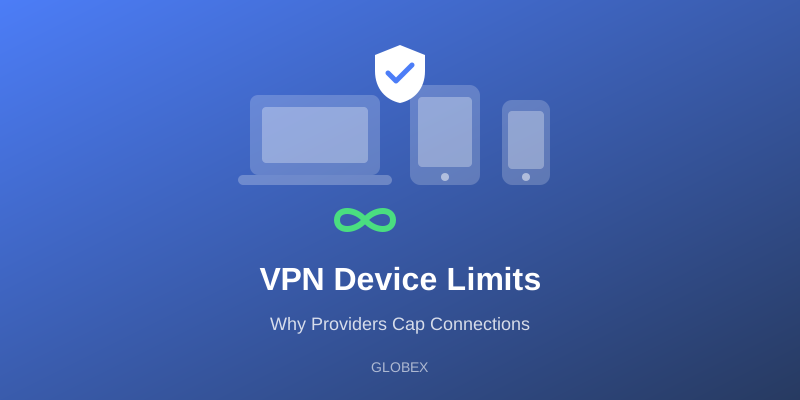
A genuinely unlimited-device policy means the provider does not count your simultaneous connections at all: every phone, tablet, and laptop in the household can run the VPN at the same time under one account, with no session being pushed off to make room for another.
GLOBEX takes this approach: unlimited devices on all plans, including the free tier. There is no signup, no account, and no credit card required to start, so there is also no per-account counter ticking against you — you install the app on a device, connect, and that device is protected. The free tier carries no daily data cap and no speed cap tied to payment, and it runs the same 8 connection protocols as Premium. What Premium adds is an ad-free experience, priority server access, and priority support — not a higher device allowance, because the device allowance is already unlimited for everyone.
When you evaluate any provider's "unlimited" claim, check the fine print for three things: whether "unlimited" refers to simultaneous connections or merely installations, whether a fair-use clause quietly reintroduces a cap, and whether the unlimited policy applies to the plan you are actually buying or only to a top tier.
Device Limits and Free VPNs
Free tiers are where device restrictions tend to be strictest across the industry, because free users generate the least revenue per unit of server load. Restrictions on free plans commonly show up as fewer allowed connections, fewer available locations, or throttled speeds. If you are comparing free options, the number of devices you can protect at once is just as important as speed or data allowances — a free VPN that covers only one device at a time protects one slice of your digital life and leaves the rest exposed. Speed on shared free infrastructure is its own topic, and if your free VPN feels slow, server crowding is a more likely cause than your device count — our related reading below covers why.
The Bottom Line
Device limits are a business lever dressed up as a technical necessity. They push households into rationing security, and rationed security is weaker security. Whether you choose GLOBEX or any other provider, favor services whose policies let every device you own stay protected all the time — because the device you leave uncovered is the one that will eventually matter.
Quick FAQ
Does a device limit count installations or connections? For most providers, simultaneous connections — you can usually install the app on more devices than you can connect at once. Always verify in the provider's own documentation.
Does GLOBEX limit devices on the free plan? No. Unlimited devices applies on all plans, free tier included.
Can a router count as one device? On providers that support router installation, a router typically counts as a single connection even though it covers the whole network. GLOBEX is an Android app available on Google Play, so its protection is per-device rather than router-based.