Why a Free VPN Comparison Is Harder Than It Looks
In short: free VPNs are not one product category — they are at least four different business models wearing the same label. Some limit your data, some limit your speed, some show you ads, and some quietly monetize the very traffic you asked them to protect. A useful free VPN comparison starts by asking how each service pays its server bills, because that answer predicts almost everything else: the limits you will hit, the speeds you will get, and the risks you are taking.
Search for "best free VPN" and you will find dozens of lists that rank apps by star ratings and feature checkboxes. That approach misses the point. Two free VPNs with identical feature lists can be complete opposites in practice if one is funded by a paid tier and the other is funded by selling browsing data. This guide compares the free VPN landscape of 2026 by funding model first and features second, tells you exactly where GLOBEX sits in that landscape, and is honest about what our competitors do well.
The Four Kinds of "Free" VPN
Running a VPN costs real money — servers, bandwidth, and engineering are all ongoing expenses. Every free VPN answers the question "who pays?" in one of four ways.
1. Freemium: the free tier funds itself through upgrades
This is the most common reputable model. The provider offers a genuinely usable free tier and makes its money when a fraction of free users upgrade to a paid plan. The free tier is a marketing channel, so the provider has a direct incentive to make it good — but also an incentive to hold something back so that upgrading still makes sense. What gets held back varies: some providers restrict data, some restrict speed, some restrict server choice, and some restrict nothing but show ads.
2. Data-capped free plans
Many free tiers in this category give you full speed but a fixed allowance of data per day or per month. The allowance is typically enough for occasional browsing but runs out quickly with video, large downloads, or all-day use. If your usage is light and predictable, a data-capped plan can work; if you want a VPN that is simply on all the time, a hard cap makes that impossible.
3. Speed- or server-limited free plans
Other free tiers take the opposite trade: no data cap, but free users are placed on a smaller set of shared servers, sometimes with an explicitly lower speed class. ProtonVPN is the best-known example of this model, and to its credit it is transparent about the trade-off — we cover it in detail below.
4. "Free" with no visible business model
This is the category to avoid. If an app offers unlimited everything, has no paid tier, no identifiable company behind it, and requests permissions that have nothing to do with networking, the most likely explanation is that you are the product: logged activity, injected ads, or resold bandwidth. No feature list compensates for a funding model you cannot explain.
How ProtonVPN's Free Tier Compares
ProtonVPN deserves specific, honest treatment because it is one of the most recommended free VPNs, and much of that reputation is earned. Two things stand out as of 2026.
First, the good: ProtonVPN's free plan does not cap your data. That is genuinely rare among data-limited competitors and worth saying plainly — if a hard monthly allowance is your main objection to free VPNs, ProtonVPN removes it.
Second, the trade-off: ProtonVPN's free tier is a speed-class product. As of 2026, its free users share 1 Gbps servers while paid users get 10 Gbps servers, and the app itself labels free-server speed as "medium." Independent tests have reported significant slowdowns on the free servers, which is consistent with how shared, lower-capacity infrastructure behaves under load. None of this is hidden — it is the deliberate design of the tier: unlimited data, slower lane.
So the ProtonVPN question is really: do you want unlimited data at reduced speed with the trade-offs of shared free servers? For a fuller side-by-side, see our dedicated comparison page at GLOBEX vs ProtonVPN.
Where GLOBEX Sits in This Comparison
GLOBEX takes the ads-funded branch of the freemium model, and we think it is the most honest version of "free" available. Here is exactly what the free tier includes — no asterisks:
- Unlimited bandwidth. There is no daily data cap and no speed cap tied to payment. Free users are not placed in a slower lane.
- No signup, no account, no credit card. You install the app and connect. There is no email harvesting step because there is no email step at all.
- Unlimited devices. Every plan, including free, works on as many devices as you own.
- All 8 connection protocols. The free tier uses the same 8 protocols as Premium — including IKEv2, Shadowsocks, V2Ray/Reality, Hysteria2, and OpenVPN — with the same encryption. Reality and Hysteria2 in particular are engineered for restrictive networks, which matters if you connect from a region where ordinary VPN traffic is blocked.
- A global server network on the free tier. Premium adds priority server access on top.
- Supported by occasional ads. This is the funding model, stated plainly: ads pay for the free tier, so your data does not have to.
What does Premium add? Three things: an ad-free experience, priority server access, and priority support. Notice what is *not* on that list — data, speed, devices, and protocols are identical on both tiers. You can read the full free-tier details at our free VPN page.
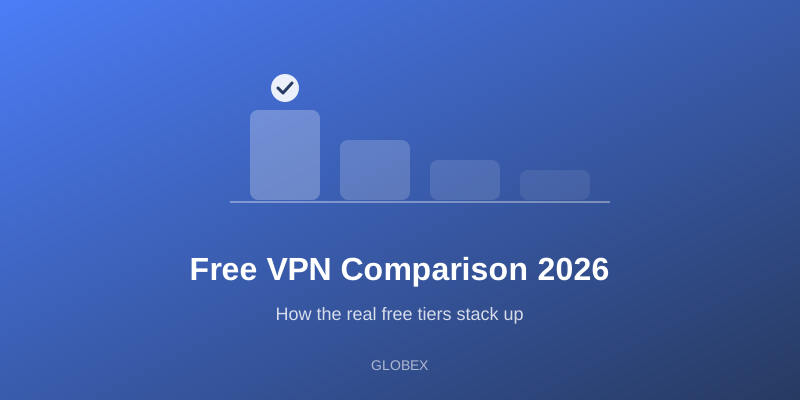
Free VPN Comparison Table
| Model | Data | Speed | Account required | How it is funded |
|---|---|---|---|---|
| GLOBEX free tier | Unlimited, no daily cap | No speed cap tied to payment | No — no signup, no credit card | Occasional ads + Premium upgrades |
| ProtonVPN free (as of 2026) | No data cap | Shared 1 Gbps servers vs 10 Gbps paid; labeled "medium"; independent tests have reported significant slowdowns | Account required | Paid-tier upgrades |
| Data-capped free plans (category) | Fixed daily or monthly allowance | Varies by provider | Usually | Paid-tier upgrades |
| "Free" apps with no visible business model (category) | Often "unlimited" | Varies | Varies | Unclear — often your data or your bandwidth |
For the category rows we deliberately avoid naming specific caps or speeds, because those numbers change constantly and vary by provider. The pattern is what matters: know which category an app belongs to before you install it.
Named free plans, verified against the providers' own pages
The category table above is deliberately number-free. This one is the opposite: every cell below was checked against the provider's own published pages on 2026-08-18 — not against review-site summaries. Providers whose own pages we could not verify that day (for example, hide.me blocks automated access to its site) are simply not in the table rather than guessed at. If a number here disagrees with what a provider's site says when you read this, trust their site: free-tier terms change.
| Free plan (checked 2026-08-18) | Data cap | Signup required | Credit card | Device limit | Speed policy | Ads |
|---|---|---|---|---|---|---|
| GLOBEX | Unlimited | No | No | Unlimited | No cap tied to payment | Occasional ads fund the free tier |
| Proton VPN Free | Unlimited ("no data or speed limits") | Yes — account creation | Not required | 1 device | "No speed limits" per its current page | No ads |
| Windscribe Free | 10 GB/month with a confirmed email; 2 GB/month without | Yes — account (email optional) | Not required | No device limit | "No throttling" per its knowledge base | Not stated on the checked pages |
Method: we loaded each provider's own free-plan page (protonvpn.com/free-vpn; windscribe.com's use-for-free and knowledge-base pages) on the check date and copied what they state, quoting their wording where it matters. GLOBEX figures are this site's own published terms. That is the entire method — no scores, no affiliate weighting, and no cells filled from memory.
A Comparison Point Most Lists Skip: Restrictive Networks
Most free VPN comparisons are written from countries with an open internet, so they never test the scenario where a VPN matters most: networks that actively detect and block VPN traffic. On those networks, the question is not how fast a free tier is but whether it connects at all. Standard VPN protocols are encrypted, but their traffic patterns are recognizable to deep packet inspection, and a filtered network can simply drop them.
This is a deliberate part of GLOBEX's design. The protocol set on the free tier includes Reality and Hysteria2 — protocols engineered for restrictive networks, built to make VPN traffic blend in with ordinary internet traffic instead of merely encrypting it. GLOBEX is engineered with a Middle East focus precisely because that is where these conditions are common. If you regularly connect from a heavily filtered network, put "does it use censorship-resistant protocols, and are they on the free tier?" at the top of your comparison checklist — many providers reserve advanced capabilities for paid plans, or do not offer this class of protocol at all. On GLOBEX, all 8 protocols are on the free tier.
How to Run Your Own Comparison
Whatever list you are reading — including this one — verify a free VPN yourself before trusting it with your traffic. Five checks cover most of the risk:
1. Find the funding model. If the provider has a paid tier or clearly disclosed ads, the free tier has an honest explanation. If you cannot work out who pays, walk away.
2. Read the privacy policy for logging specifics. "We value your privacy" is a slogan; "we do not log browsing activity" is a claim you can hold them to. Vague policies are a red flag in themselves.
3. Check the permissions the app requests. A VPN needs network access. It does not need your contacts or your SMS messages.
4. Look for an identifiable company. A real company name, a support address, and a history you can search are basic accountability. GLOBEX, for example, is reachable at support@globexvpn.com.
5. Test the limits yourself. Install the app and use it for a day. Data caps, speed classes, and ad frequency are all observable within hours — you do not have to take anyone's word for them.
The Honest Bottom Line
There is no single "best free VPN" — there is a best fit for how you use the internet. If you want unlimited data and can accept a slower shared lane and creating an account, ProtonVPN's free tier is a credible, transparently designed option. If your usage is light and predictable, a data-capped plan from a reputable freemium provider can be enough. If you want unlimited data *and* no payment-tied speed cap *and* no account, with the trade-off of occasional ads, that is exactly the niche GLOBEX built its free tier for — and if you later want the ads gone, Premium removes them without changing anything else about the service.
The one universally correct answer in any free VPN comparison: never use a free VPN whose business model you cannot explain in one sentence.
FAQ
What is the best free VPN in 2026?
There is no single best free VPN — it depends on which trade-off you prefer. Free VPNs generally limit data, limit speed, show ads, or (the dangerous ones) monetize your traffic. GLOBEX's free tier is the ads-funded kind: unlimited bandwidth, no daily data cap, no account required, and the same 8 protocols as Premium, funded by occasional ads. ProtonVPN's free tier is the speed-class kind: no data cap, but as of 2026 free users share 1 Gbps servers versus 10 Gbps for paid users. Choose by trade-off, not by star rating.
Are free VPNs safe to use?
A free VPN from a provider with a clear funding model — a paid tier, disclosed ads, or both — and a specific no-logging policy can be safe. The unsafe ones are apps with no visible business model: if you cannot tell who pays for the servers, the likely answer is that your data or bandwidth does. Check the privacy policy, the requested permissions, and whether a real company stands behind the app before installing.
Does GLOBEX limit data or speed on the free plan?
No. The GLOBEX free tier has unlimited bandwidth with no daily data cap and no speed cap tied to payment. It also requires no signup, no account, and no credit card, and supports unlimited devices. The free tier is supported by occasional ads; Premium adds an ad-free experience, priority server access, and priority support.
Is ProtonVPN's free plan really unlimited?
ProtonVPN's free plan does not cap your data, which is genuinely rare and worth crediting. The trade-off is speed and servers: as of 2026, free users share 1 Gbps servers while paid users get 10 Gbps servers, the app labels free speed as "medium," and independent tests have reported significant slowdowns on free servers. Unlimited data, slower lane — that is the design.
Do free VPNs sell your data?
Some do — specifically the ones with no other way to pay their bills. A free tier funded by a paid tier or by disclosed ads has an honest revenue source and no need to monetize your browsing. A "free unlimited" app with no paid tier, no company information, and invasive permissions almost certainly monetizes you somehow. The funding model is the single best predictor.
Can I use a free VPN on multiple devices?
It varies by provider — device limits are a common free-tier restriction in the industry. GLOBEX allows unlimited devices on all plans, including the free tier, with no account needed on any of them.